The Loan Rail: How to Dress for December Without Adding to the Wardrobe
There is a particular kind of December panic that arrives around the second week, usually while you are standing in front of a wardrobe that has somehow forgotten every party you have ever attended. The invitations stack up — the office do, the neighbourhood drinks, the friend's fortieth that has somehow landed on a Thursday — and the instinct is to buy something new. Not because you need it, but because the rail in front of you feels like it belongs to a woman with a different social life.
This year, try something else. Your circle is a wardrobe. Between the women you know, there is almost certainly a black-tie-adjacent dress that fits, a pair of heels in your size, a bag that would finish the job. The borrowed dress economy is not a compromise; it is a quiet flex. It says you know what style actually costs — and what it does not need to.
Start with an inventory, not a wishlist
Before you ask anyone for anything, map out the month. Write down every event and the dress code, then look at what you already own. Be honest about the gaps. You might find you need one good pair of trousers, not four new dresses. You might realise the sequined top you bought in a moment of weakness finally has a home.
The goal is not to borrow a whole new personality. It is to fill the specific holes that a real December creates. If you are short a cocktail dress for one night and one night only, borrowing is not just sensible — it is the most stylish decision in the room.
How to ask without making it awkward
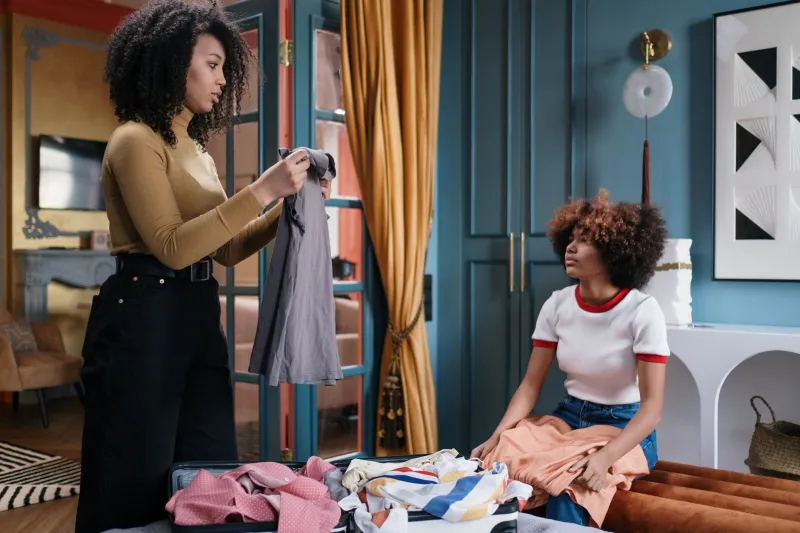
Asking to borrow clothes can feel strangely intimate, as if you are admitting your own rail is lacking. Reframe it. Most women are delighted to lend a piece that has been sitting unloved since last Christmas. The trick is to be specific and to make the ask easy to refuse.
Try: "I have a thing on the 14th and I keep thinking of that emerald dress you wore to the winter supper — would you ever consider lending it for the night? Totally fine if not." That is far better than a vague "have you got anything I could borrow?" which puts the work on them and makes a no feel rude.
Offer reciprocity in the same breath. "And obviously if there is anything of mine you want to take for a spin, say the word." It turns a favour into an exchange, even if the exchange is not immediate. You are not a charity case; you are a fellow stylist with a shared rail.
Set terms like an adult
A borrowed dress should come with a small, unspoken contract. Make it spoken. Agree the return date before the item leaves the house. Confirm whether they want it dry-cleaned or simply aired and pressed. Ask if there are any rules — no red wine, no smoking, no sitting on the floor of a taxi. If the piece is genuinely valuable, offer to cover the cost of cleaning either way. It is a small gesture that keeps the rail open for next year.
If you are the lender, say what you need too. "I would love you to take it, but I need it back by the 20th and please don't put it in the washing machine." Clear terms are not distrustful; they are what trust looks like when it is written down.
The alteration conversation
Sometimes a borrowed piece is almost right. The straps are a touch long, the hem sits an inch low, the waist needs a nip. Before you do anything, ask. Never alter a borrowed item without explicit permission.
If you get the green light, keep it reversible. Use safety pins, temporary hem tape, a quick stitch that can be unpicked. If it needs proper tailoring, offer to pay for it and make sure the original shape can be restored. A good local seamstress can work wonders for £20, and a borrowed dress that fits you properly will look more like yours than anything you could pull off a shop rail.
Make it feel like your own
The difference between a borrowed dress and a borrowed-dress situation is styling. Do not simply wear it the way your friend did. Change the shoes. Add your own jewellery. Swap the clutch for something smaller and stranger. If the dress is slinky, make it edgy with a cropped knit and ankle boots; if it is structured, soften it with a bare leg and a low heel.
This is also where the High Wife standard comes in: a borrowed piece should never look like a costume. It should look like a decision. Press it, steam it, hang it on a proper hanger. Take care of it as if it were yours, because for the evening it is.
Returns that keep the friendship intact
Return it clean, pressed and on time. Add a small note — not a grand gesture, just a line that says thank you and tells them where you wore it. If you spilled something, say so before they find out. If you had it cleaned, include the ticket. These are the details that turn a one-off loan into a standing arrangement.
And if you borrowed something that made you feel genuinely brilliant, tell them. Women lend clothes because they want to see them live. A text that says "I felt like a different person in that dress, thank you" is worth more than any dry-cleaning receipt.
When to say no
Not every rail should be open. If you are precious about a piece, or if the borrower has a history of returning things late or not at all, you are allowed to decline. "I am not ready to let that one out of the house yet" is a complete sentence. The borrowed dress economy only works when both sides are honest about what they can offer.
December is not a test of how much you can buy. It is a test of how well you can edit. This year, before you add another dress to the pile, look around your circle. There is a good chance the answer is already hanging in someone else's spare room — and that the best party season is the one you put together yourself.