12 Quiet-Luxury Details That Make a Home Feel Expensive (No Reno Required)
The festive season has a way of making you reassess your own hallway. Suddenly the ceiling light looks too bright, the console table looks like a lost property box, and the spare room is best described as storage with a bed in it.
Here's the good news: none of that requires a renovation. The things that make a home feel expensive are almost never structural. They're the layers between the walls and the people standing in them — the sort of details you don't notice individually but you absolutely notice when they're missing. Below are the twelve I come back to every single year, all with a high-street price tag and a distinctly quiet-luxury result.
Fix the light before you fix anything else
1. Warm bulbs, and a break-up with your big light. Swap anything cool-white for 2700K warm white (B&Q and John Lewis both sell multipacks for less than a takeaway) and then carry on as if the ceiling light doesn't exist. Lamps beat overheads every time — three sources at three heights in a living room, one in the hall, one in the kitchen corner. A plug-in dimmer costs about a tenner and turns any lamp into mood lighting. Nothing dates a room faster than a bulb that makes everyone look like they're about to be interviewed.
2. Apply the 60% rule to your surfaces. Expensive-looking homes tend to be about 60% empty. Clear the console down to a lamp, a small stack of books and one object you genuinely love. Same for the kitchen counter, the windowsill, the coffee table. Anything with a charger or a pile of post attached goes in a drawer. Then group the survivors on a tray — Dunelm, H&M Home, or wherever the Homesense gods take you — and three random things suddenly look deliberate.
3. Treat your hallway like a hotel lobby. Guests form an opinion of your home in the eight seconds it takes to hand over a coat. So: a doormat that isn't curling at the corner, a hook or a basket for bags, one low lamp, a mirror. A heap of coats on a chair reads chaos; a row of hooks reads calm. Add something nice-smelling and you've basically built a boutique lobby in two square metres.
Set the table like you mean it
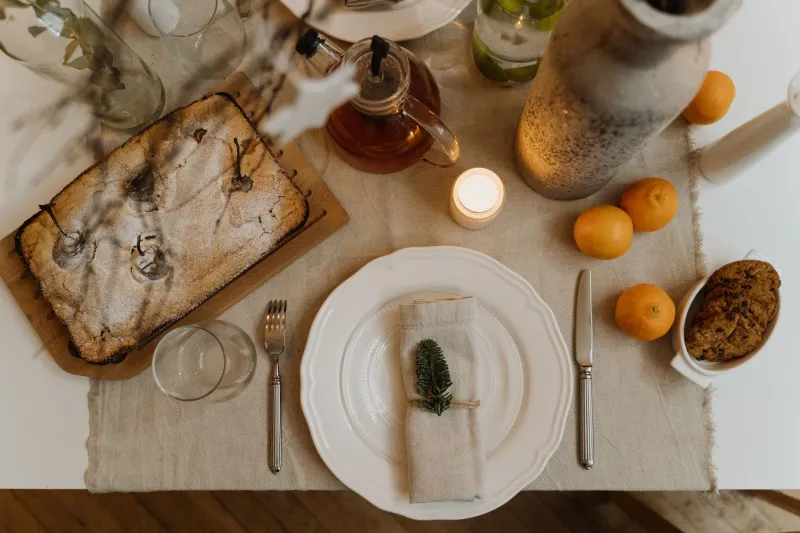
4. Iron your table linen — yes, really. This is the most effective trick on the list. A pressed linen-blend cloth or runner is the difference between 'we'll eat on our laps' and 'this is an occasion'. M&S and H&M Home both do decent linen mixes around the £20 mark, and a plain cream or putty shade works with everything. If a whole cloth feels like a commitment, use a runner — 90 seconds with the iron and the table feels anchored.
5. Use cloth napkins. Printed paper napkins will quietly undo every other good thing you've done. Cloth ones needn't cost much: a pack of four cotton napkins from Zara Home, or a charity-shop find, folded plainly on the plate. That's the entire styling instruction. Nothing more.
6. Plain plates, heavy cutlery. Plain white or warm cream crockery makes food look better and instantly reads more expensive than anything patterned. If yours is chipped or mismatched, Dunelm and John Lewis both run open-stock ranges where you can buy exactly what you need for around £5 a plate. Then put your money into cutlery with a bit of weight — you notice it the second you pick it up, and so will everyone else.
7. Polish the glasses properly. Clear glass, thin rims, one style for everything. Charity shops are heaped with crystal nobody wants, and it looks like a fortune once it's washed and buffed. The polishing is the point: hot water, a clean tea towel, no streaks. Streaky glasses read pub. Gleaming ones read dinner party.
8. Bring a jug of water to the table. Restaurants do it; we forget. A glass jug of iced water with a couple of lemon slices or a sprig of rosemary means nobody's getting up mid-sentence and the whole table looks considered. Same logic applies to everything else — pour drinks into something before guests arrive rather than leaving bottles and cans lined up on the worktop.
9. Decant the snacks. Crisps into a bowl, nuts into a small dish, olives onto a little plate with a spoon. Packaging shrinks the perceived price of everything around it. You don't need new bowls. You need to transfer the contents.
Then the bits nobody credits but everybody notices
10. Pick one flower and buy too many of it. Single-variety bunches look expensive; mixed supermarket bouquets look like mixed supermarket bouquets. Twenty tulips, all the same colour, in a low vase — that's the whole trick. Waitrose and M&S are reliably good value in my experience, and a bowl of clementines or a pot of forced hyacinths does the same job in November when you can't face buying stems.
11. Layer scent, but only slightly. Smell is the thing guests never mention and always remember. A reed diffuser in the hall, one candle in the living room, and a simmer pot on the hob (orange peel, a cinnamon stick, a star anise, water, half an hour) is plenty. Do not put a scented candle on the dining table — it will fight the food and everyone will leave smelling of fig.
12. Sort the music, then give the bathroom a once-over. Music with no ad breaks, at a volume people still have to lean in to talk over. Then the bathroom: a folded hand towel, a decent pump hand wash, a bin with a lid, and a spare loo roll out on display rather than hidden in a cupboard. Five minutes, and it's the detail that quietly tells people you thought about them.
What I'd skip entirely
Anything monogrammed. Cling film over dishes. Panic-buying a full matching dinner service on Christmas Eve. And over-styling to the point where a guest can't put a glass down without rearranging a tablescape. The whole effect collapses the moment people feel they can't relax.
Because that's the thing about a home feeling expensive: it isn't really about looking rich. It's about looking like somebody has taken care of it — and, by extension, of the people in it. A warm bulb, a pressed cloth and a bowl of something to eat is honestly most of the way there.