After Dark: A Room-by-Room Lighting Audit for the Four O'Clock Blackout
By four o'clock on a November afternoon, most British homes quietly change character. The curtains get pulled, the lamps go on, and the room you spent all autumn getting right suddenly has the atmosphere of a dental surgery. Nothing has moved. Nothing has been broken. The problem is above your head and behind your sofa, and it has been there since the clocks went back.
We are a nation of reasonably confident furniture buyers and genuinely terrible lighting buyers. We will agonise for three weeks over the difference between two nearly identical greys on a sofa, then screw in whatever bulb came out of the kitchen drawer. Then we wonder why the whole effect reads as flat, cold and faintly municipal by 5pm.
The good news: this is the cheapest fix in the house. Cheaper than cushions. Considerably cheaper than the curtains. Below is the audit I do every November, room by room, plus the small spends that make the biggest difference.
Start with the bulb, not the furniture
Before you buy a single lamp, go round the house and read the boxes in your light fittings. Most UK homes are running a chaotic mix of colour temperatures — the warm one from the hall, a leftover 4000K 'daylight' bulb someone put in the bathroom, a cool white in the kitchen because it felt 'cleaner'.
What you want in living spaces is 2700K, occasionally 3000K. That is the warm, slightly honeyed end of the scale. Anything at 4000K and above is a work light — correct in a garage, wrong over a dining table. Once you have warmed the bulbs, everything else in the room improves for free: paint looks richer, wood looks warmer, and the slightly grey-blue tinge that photographic filters exist to fix simply disappears.
Two other numbers matter. Lumens, not watts, tell you how bright it actually is — a 60W-equivalent warm bulb is roughly 800 lumens. And if you are replacing a lot at once, look for a high CRI (90+) on the box; it is the difference between skin looking alive and skin looking like a spreadsheet.
The three-lamp rule
One ceiling light per room is not lighting. It is illumination, which is a different thing. The rule that quietly separates a room that photographs well from one that doesn't is simple: three separate light sources, at three different heights, in every room you sit in.
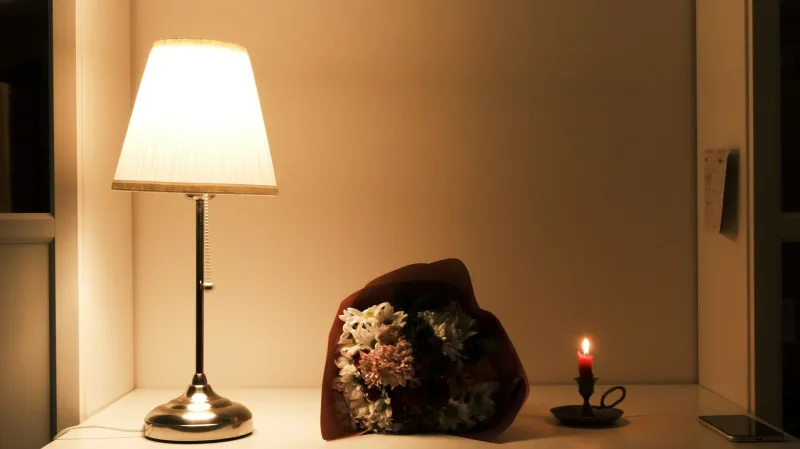
A floor lamp, a table lamp, and something low — a picture light, a small lamp on a bookshelf, a candle. Layer them and the room develops depth, because light is coming from more than one direction and shadows stop being flat. It is the same principle a photographer uses in a studio, executed with a £25 lamp from Dunelm.
Evict the big light
I am not going to pretend the ceiling light should be removed from the house. Hallways, bathrooms and utility rooms can keep theirs. But in a sitting room or dining room, the overhead fixture is the single biggest killer of a good evening at home. It flattens faces, exaggerates every speck of dust, and makes a well-chosen room look like a rental.
Try a week with it off. Use lamps only, and see how quickly the room starts to feel like somewhere you'd choose to sit rather than somewhere you're waiting to be called in.
The sitting room
Start here, because this is where the damage is most visible. Warm the bulbs to 2700K. Put a floor lamp behind one end of the sofa rather than beside it — backlighting softens the whole arrangement. Add a table lamp at the other end at roughly eye level when you're seated. If you have a picture, a shelf or a plant you actually like, give it its own small light.
Then put at least two of those lamps on a dimmer or smart plugs. Lowering the light at 8pm is the cheapest way to make an evening feel like an occasion.
The kitchen
Kitchens are the one room where a brighter, cleaner light genuinely earns its keep — task lighting over the hob and worktop is not vanity, it's how you avoid chopping a fingertip. Keep 3000K under the cabinets. But kill the cold overhead glow once dinner is over and switch to a single warm lamp on a side surface, or a low pendant over the table if you have one. Kitchens are allowed to have two moods.
Hall, stairs and landing
The most neglected square footage in the country. A warm bulb and one small lamp on the landing — even a cheap rechargeable one — transforms the walk to bed. If you have a stair runner and no light on it, you have decorated a corridor you cannot see.
The bedroom
Nothing good happens under a central bedroom light. Two bedside lamps with warm bulbs, both dimmable, and ideally nothing else on. If you read in bed, angle the shade so the light falls on the page and not across the room — the difference between falling asleep at eleven and falling asleep at one.
The bathroom
This is where warm light flatters most and cold light punishes hardest. Swap the 4000K bulb. Add a light either side of the mirror if you have the wiring, or a small plug-in picture light above it if you don't. You will look better in your own bathroom immediately, which is worth more than most skincare.
The £30 fixes that read as expensive
- Five warm bulbs. Around £15 for a pack. The single highest-return purchase in the house.
- A plug-in dimmer or smart plug. £10–£15. Instantly turns any lamp into mood lighting.
- A second-hand floor lamp. Charity shops and Facebook Marketplace are full of them for £10–£20. Rewire if needed.
- A warm-white LED strip behind a shelf or the telly. Under £15, and it removes the black rectangle effect on the wall.
The point of the audit
Your house isn't dark. It is unevenly lit, too cool in the places you sit and too bright in the places you don't. Fix the temperature, layer three sources into each room, and turn the big light off. By the time the clocks go back next year you'll have stopped blaming the paint.